
- Home
Edition
Africa Australia Brasil Canada Canada (français) España Europe France Global Indonesia New Zealand United Kingdom United States Edition:
Global
Edition:
Global
- Africa
- Australia
- Brasil
- Canada
- Canada (français)
- España
- Europe
- France
- Indonesia
- New Zealand
- United Kingdom
- United States
Academic rigour, journalistic flair
 Using puzzles, both at home and in classrooms, can restore the often-forgotten truth that learning happens in conversation.
(Getty Images/Unsplash)
Jigsaw puzzles help make mathematics learning more active and fun
Published: December 11, 2025 7.23pm GMT
Francis Duah, Toronto Metropolitan University
Using puzzles, both at home and in classrooms, can restore the often-forgotten truth that learning happens in conversation.
(Getty Images/Unsplash)
Jigsaw puzzles help make mathematics learning more active and fun
Published: December 11, 2025 7.23pm GMT
Francis Duah, Toronto Metropolitan University
Author
-
 Francis Duah
Assistant Professor, Department of Mathematics, Toronto Metropolitan University
Disclosure statement
Francis Duah does not work for, consult, own shares in or receive funding from any company or organisation that would benefit from this article, and has disclosed no relevant affiliations beyond their academic appointment.
Partners

Toronto Metropolitan University provides funding as a founding partner of The Conversation CA.
Toronto Metropolitan University provides funding as a member of The Conversation CA-FR.
View all partners
DOI
https://doi.org/10.64628/AAM.n6d6jqq73
https://theconversation.com/jigsaw-puzzles-help-make-mathematics-learning-more-active-and-fun-270857 https://theconversation.com/jigsaw-puzzles-help-make-mathematics-learning-more-active-and-fun-270857 Link copied Share articleShare article
Copy link Email Bluesky Facebook WhatsApp Messenger LinkedIn X (Twitter)Print article
Holidays bring celebration, rest and, for many families, long stretches of indoor time. For some, this means table top games quickly reappear on kitchen tables. Games provide opportunities for learning mathematics actively.
These moments of playful learning raise a broader question: how can we support student’s mathematical learning at home without turning the holidays into formal lessons?
One answer comes from a simple but surprisingly powerful classroom learning tool: Tarsia jigsaw puzzles. These are puzzles created with free Tarsia software, from Hermitech Laboratory. The software enables people to create, print out and save customized jigsaws, domino activities and different rectangular card-sorting activities.
For the mathematics classroom, the whole sheet of a Tarsia puzzle printed on paper is typically laminated (for repeated use) before being cut into pieces.
Social and active learning that values mistakes
Canadian mathematician Anthony Bonato advises: “No matter what method is used to teach math, make it fun.” Most students would agree; joy is often missing from their experience.
As a mathematics education researcher, I add that regardless of the method used to teach mathematics, the learning should be active and social, and value mistakes as opportunities for learning. These are conditions under which learners feel safe to try, fail and try again.
Tarsia puzzles, which have been around for more than a decade and have found use in K-12 classrooms, accomplish all of this with almost no explanation for students. However, their use in university calculus classrooms appears to be rare.
My research has focused on why using Tarsia puzzles work to teach math, and their impact in the undergraduate classroom.
Matching geometric tiles
The Tarsia software allows teachers to embed mathematical relationships — fractions, functions, graphs, algebraic expressions — into geometric tiles such as triangles, rectangles or rhombus.
Learners must match the tiles so that the edges align, eventually forming a complete single shape.
The Tarsia software presents users with a variety of puzzle types to choose from.
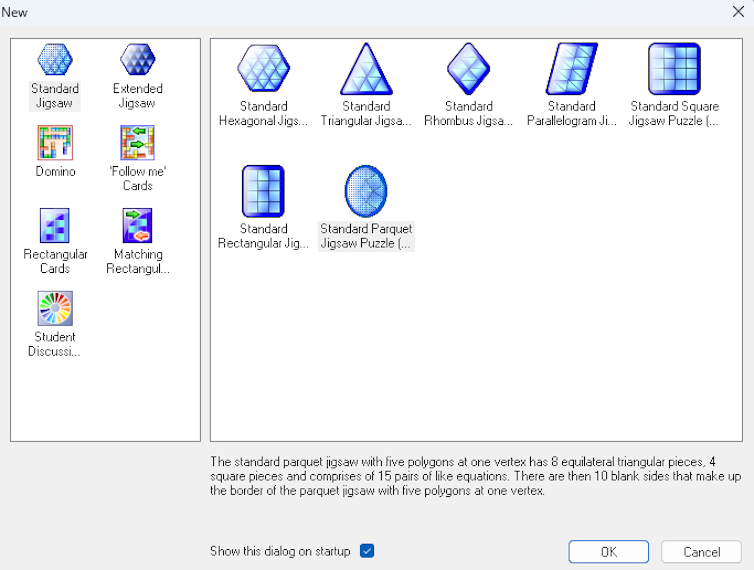 Different types of Tarsia puzzles are available in the software.
(Francis Duah)
Different types of Tarsia puzzles are available in the software.
(Francis Duah)
Teachers in elementary and secondary schools use Tarsia puzzles to strengthen number sense and deepen understanding of functions, graphs and algebraic relationships. University instructors can use them to enliven topics such as limits, derivatives and integration — areas where students often feel intimidated.
Mathematical ‘prompts’
Each tile carries a mathematical “prompt” — for example, an appropriate Tarsia puzzle for elementary school learners might involve pieces marked with fractions, decimals and percentages, to help students understand equivalents like ¼ = 25 per cent.
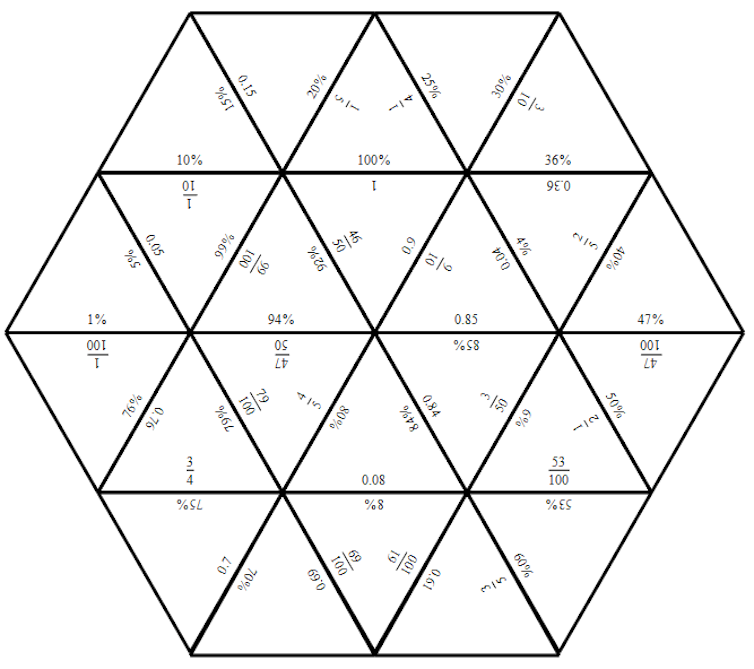 A completed puzzle on fractions, decimals and percentages that could be suitable for elementary learners.
(Francis Duah)
A completed puzzle on fractions, decimals and percentages that could be suitable for elementary learners.
(Francis Duah)
For more advanced learning, puzzle pieces might show two equivalent fractions, a logarithmic expression and its simplified form or a function paired with its graph.
In both cases, learners assemble the puzzle by identifying which pieces belong together. When all tiles are matched correctly, a single full shape emerges.
Because Tarsia puzzles emphasize recognition and relationships rather than lengthy calculations, learners think about how ideas connect. They compare expressions, notice graphical features and reason out equivalence. In many ways, the activity mimics authentic mathematical thinking.
Tarsia puzzles require little supervision, and most of students’ learning happens in the conversations around the table — not in written solutions.
Grades 11 and 12 math students might use a Tarsia puzzle on logarithms — part of learning about exponents or “the power to which a base must be raised to yield a given number.”
Why active learning matters
Decades of research show that students learn mathematics best when they talk through problems, test ideas and make mistakes in low-pressure settings. Studies confirm that active learning improves understanding, reduces failure rates and builds confidence across STEM subjects.
Yet many mathematics classrooms still operate as one-way lectures, where students quietly copy procedures and hope to follow along.
Tarsia puzzles reverse this pattern. They create structured, collaborative problem-solving that feels more like play than assessment. A student who dreads formal proofs may still be eager to match a derivative with its graph. Another who dislikes fractions may feel less pressure when an incorrect guess simply means trying another tile.
A challenging puzzle might combine square and triangular pieces into a 10-sided figure, helping to teach limits, sequences, series and partial derivatives in multivariable calculus.
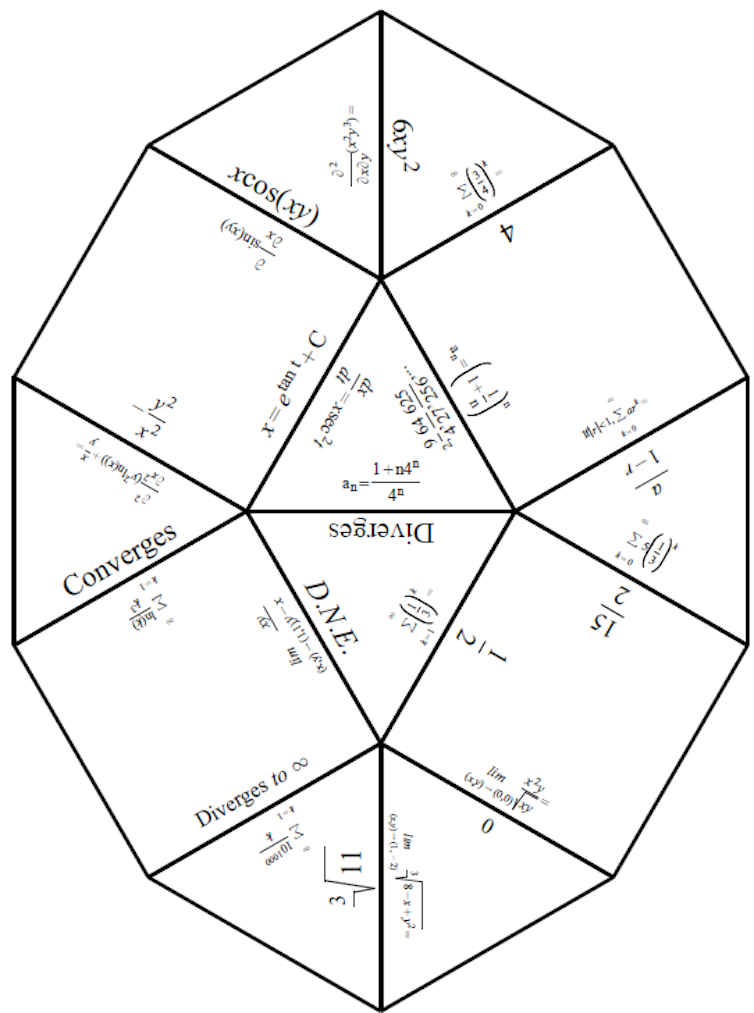 A completed puzzle on limits, sequences, series and partial derivatives.
(Francis Duah)
A completed puzzle on limits, sequences, series and partial derivatives.
(Francis Duah)
Recent study
At Toronto Metropolitan University’s active learning classroom, colleagues and I explored how Tarsia puzzles help first-year students learn calculus, relying on structured reflection and student feedback to examine our own teaching practices.
Several themes consistently emerged from the analysis of our reflective notes about students using Tarsia puzzles:
Less fear: Students who were usually anxious about being wrong participated more freely. Mistakes became part of the puzzle-solving process rather than personal shortcomings.
More talk: Learners debated ideas, explained reasoning and corrected each other — behaviours rarely observed in traditional tutorials.
Better engagement: Students worked longer and with greater focus compared with worksheet-based tasks. Some who typically packed up early stayed to complete the puzzle.
Why parents and tutors should care
Mathematics is often portrayed as solitary work, yet mathematicians collaborate constantly — arguing, checking, revising and proposing alternatives. Students benefit from similar interactions.
At home or in small tutoring groups, a Tarsia puzzle offers a low-stakes entry into mathematical reasoning. Learners who are reluctant to speak up in class may confidently identify mismatched edges or question whether two expressions are equivalent. Misconceptions are revealed naturally through the puzzle, allowing gentle correction without embarrassment.
To try Tarsia puzzles, parents and tutors of young students could try examples suitable for upper elementary and junior high school students.
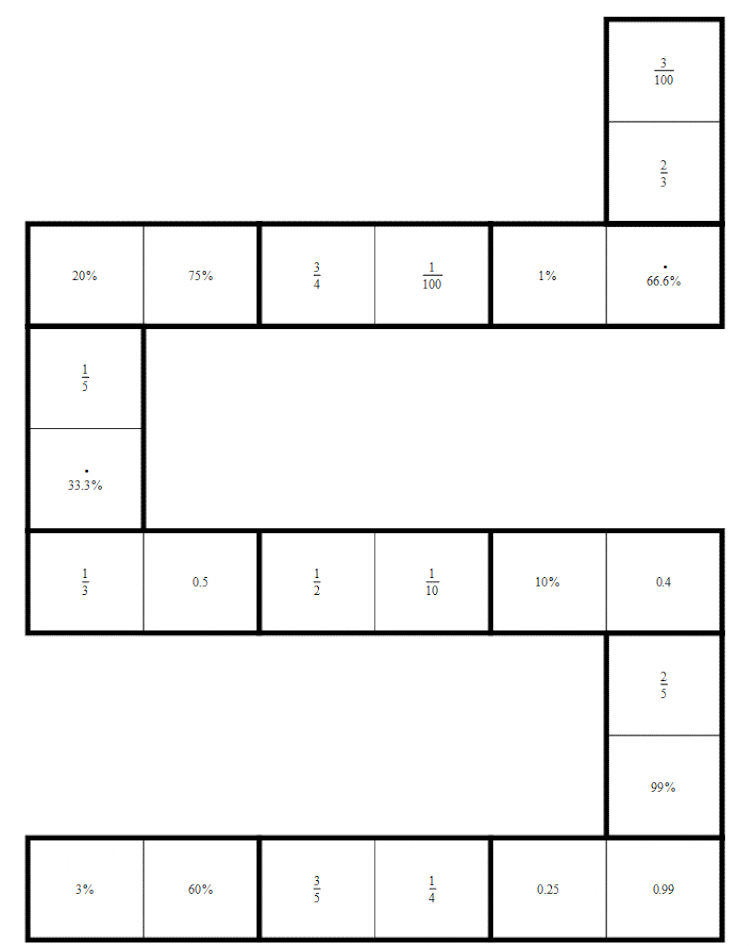 A domino-style puzzle on fractions, decimals and percentages.
(Francis Duah)
A domino-style puzzle on fractions, decimals and percentages.
(Francis Duah)
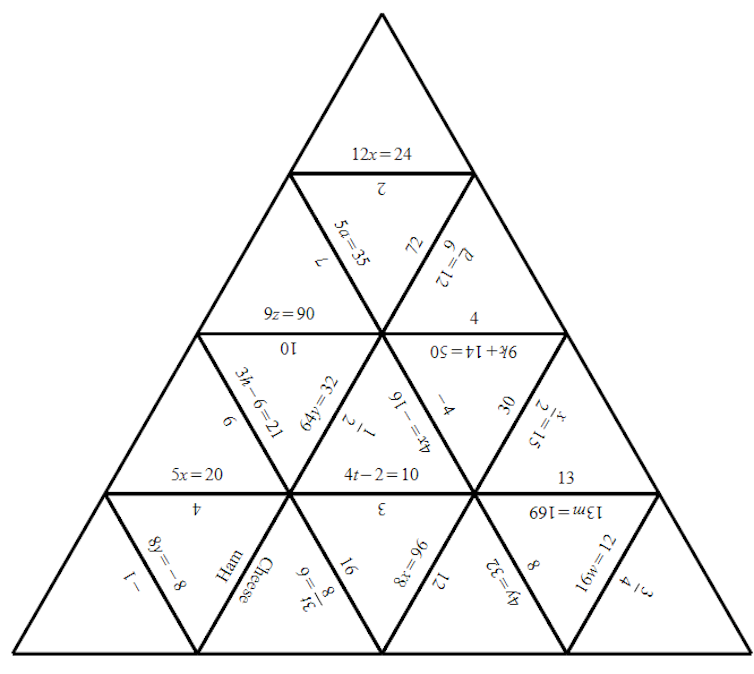 Puzzle on linear equations.
(Francis Duah)
Puzzle on linear equations.
(Francis Duah)
A call to developers
The Tarsia software is useful but dated. Currently, it operates on a Windows operating system.
A modern web-based version — with collaboration tools, curriculum-aligned templates, and built-in accessibility — would significantly expand its adoption. Educational technology developers looking for impactful, low-cost tools could find enormous potential here.
Mathematics becomes easier when it invites curiosity. Tarsia puzzles, modest in design but powerful in effect, encourage learners to talk, think and take intellectual risks. They help parents, tutors and instructors see students’ reasoning in real time, not merely their final answers.
Most importantly, they restore an often-forgotten truth: mathematics can be playful — and learning happens in conversation.
- Mathematics education
- Active learning
- Teaching math
- Calculus
- Elementary school math
Events
Jobs
-
 Talent Integrity and Contracts Advisor
-
Senior Lecturer, Educational Leadership
-
Respect and Safety Project Manager
-
Associate Dean, School of Information Technology and Creative Computing | SAE University College
-
University Lecturer in Early Childhood Education
 Talent Integrity and Contracts Advisor
 Senior Lecturer, Educational Leadership
 Respect and Safety Project Manager
 Associate Dean, School of Information Technology and Creative Computing | SAE University College
 University Lecturer in Early Childhood Education
- Editorial Policies
- Community standards
- Republishing guidelines
- Analytics
- Our feeds
- Get newsletter
- Who we are
- Our charter
- Our team
- Partners and funders
- Resource for media
- Contact us
-
-
-
-
Copyright © 2010–2025, The Conversation