
- Home
Edition
Africa Australia Brasil Canada Canada (français) España Europe France Global Indonesia New Zealand United Kingdom United States Edition:
Global
Edition:
Global
- Africa
- Australia
- Brasil
- Canada
- Canada (français)
- España
- Europe
- France
- Indonesia
- New Zealand
- United Kingdom
- United States
Academic rigour, journalistic flair
 Bloemfontein in South Africa could become a profitable astro-tourism hub.
Anton Petrus/Getty Images
Bloemfontein, South Africa: how to turn clear skies, a planetarium and an observatory into a tourist attraction
Published: December 11, 2025 1.47pm GMT
Eben Proos, Central University of Technology
Bloemfontein in South Africa could become a profitable astro-tourism hub.
Anton Petrus/Getty Images
Bloemfontein, South Africa: how to turn clear skies, a planetarium and an observatory into a tourist attraction
Published: December 11, 2025 1.47pm GMT
Eben Proos, Central University of Technology
Author
-
 Eben Proos
Senior Lecturer in Tourism and Event Management, Central University of Technology
Disclosure statement
Eben Proos does not work for, consult, own shares in or receive funding from any company or organisation that would benefit from this article, and has disclosed no relevant affiliations beyond their academic appointment.
Partners

Central University of Technology provides support as an endorsing partner of The Conversation AFRICA.
View all partners
DOI
https://doi.org/10.64628/AAJ.a9uj7r4ex
https://theconversation.com/bloemfontein-south-africa-how-to-turn-clear-skies-a-planetarium-and-an-observatory-into-a-tourist-attraction-268039 https://theconversation.com/bloemfontein-south-africa-how-to-turn-clear-skies-a-planetarium-and-an-observatory-into-a-tourist-attraction-268039 Link copied Share articleShare article
Copy link Email Bluesky Facebook WhatsApp Messenger LinkedIn X (Twitter)Print article
Astro-tourism is a niche form of tourism where visitors explore the night sky through stargazing events, guided tours, educational presentations and digital astronomy experiences. Unlike mass tourism, astro-tourism focuses on learning rather than just sightseeing.
Astro-tourism could also offer a lifeline to places that don’t have major natural resource attractions that draw tourists.
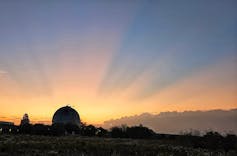 Naval Hill Planetarium in Bloemfontein.
Courtesy Mart-Mari Duvenhage
Naval Hill Planetarium in Bloemfontein.
Courtesy Mart-Mari Duvenhage
One place that could benefit from astro-tourism is Bloemfontein, situated in the heart of South Africa’s Free State province. It’s never been considered one of South Africa’s popular tourist destinations. That’s because the city lacks a major attraction like the Kruger National Park or Cape Town’s Table Mountain.
But Bloemfontein has unpolluted skies, a planetarium and an observatory. It is also accessible by air and road. It has hotels and guesthouses for tourists to stay in.
Read more: Astro-tourism − chasing eclipses, meteor showers and elusive dark skies from Earth
I’m a niche tourism researcher who set out to discover if Bloemfontein could turn those assets into an astro-tourism niche. I surveyed 160 people who were already visiting the planetarium and observatory and asked them what they thought of the facilities and services.
My research found that young people aged between 18 and 35, from the Free State and neighbouring Gauteng province just a three-hour drive away, were the most likely to become astro tourists in Bloemfontein.
It also suggested that expanding astro-tourism could boost local jobs. This would happen if entrepreneurs set up small coffee shops, information centres and local craft sales.
Read more: A big moment for Africa: why the MeerKAT -- and astronomy -- matter
Establishing astro-tourism in Bloemfontein could also highlight Indigenous knowledge of astronomy and the cultural heritage of the area.
With strong marketing, and involving local communities and cultures, my research shows that astro-tourism could generate economic benefits, create jobs, and put Bloemfontein on the map for both domestic and international visitors.
What makes Bloemfontein an astro-tourism destination
The city already has the Naval Hill Planetarium, the Boyden Observatory and Sterland, an observatory on Onze Rust farm.
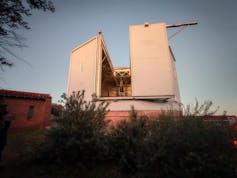 Boyden Observatory in Bloemfontein.
Courtesy Mart-Mari Duvenhage
Boyden Observatory in Bloemfontein.
Courtesy Mart-Mari Duvenhage
The Naval Hill Planetarium is located in the city on Naval Hill (a game reserve). It offers immersive digital experiences to visitors. The Boyden Observatory is an astronomical research station located 26km outside the city. It hosts frequent public events. Sterland (“star land”) offers two telescopes to gaze at the stars.
Read more: Astronomy 'Olympics' is being hosted in Africa for the first time: 4 big talking points
The other advantage of astro-tourism is that it is available all year round. Planetariums are open in all types of weather.
The people I interviewed said a few factors made Bloemfontein a good astro-tourism destination. The friendliness of the local people and astro-tourism staff counted in the city’s favour. Cleanliness, ease of driving to the area and a lower crime rate were other factors.
Read more: Why is it so hard to take a good photo of the Moon with my phone?
These are all key attributes that can either ensure success or failure of any tourism attraction. My research concluded that Bloemfontein has top astro-tourism facilities which can boost the city’s fortunes if utilised correctly. Because travellers are looking for memorable, authentic, and engaging experiences especially to lesser known destinations or tourism “gems”, this could also attract astro-tourists to Bloemfontein.
In South Africa, Sutherland has already benefited from astro-tourism. The coldest place in South Africa, Sutherland used to be a tiny sheep farming town with a population of fewer than 3,000 people. But after one of the world’s largest telescopes was installed there, as the darkest site in the world from which to stargaze, it became an astro-tourist destination. However, it’s further off the beaten track than Bloemfontein.
What needs to happen next
It is of critical importance to change people’s negative perceptions of Bloemfontein. Currently it is viewed as a city where there is nothing exciting to do on holiday.
Indigenous astronomical knowledge must be preserved and brought to the front of astro-tourism. Events and displays should be held to focus on this topic. Experts on Indigenous astronomy could also be approached to deliver addresses at the astro-tourism facilities.
Read more: How our ancestors viewed the sky: new film explores both indigenous and modern cosmology
The astro-tourist facilites also need to collaborate so that valuable knowledge is exchanged and the astro-tourism product is improved for all involved.
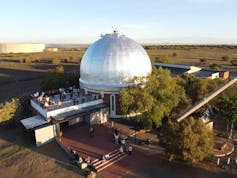 Naval Hill Planetarium, Bloemfontein.
Courtesy Mart-Mari Duvenhage
Naval Hill Planetarium, Bloemfontein.
Courtesy Mart-Mari Duvenhage
Local communities, amateur astronomy clubs, universities and museums must be drawn in as ambassadors for astro-tourism in Bloemfontein. These key role players can get involved by attending astro-tourism events. They could also take the lead in marketing astro-tourism on social media.
Apart from this, the city needs a strong, dedicated marketing initiative to highlight the impressive astro-tourism products that are currently available.
Read more: MeerKAT: the South African radio telescope that's transformed our understanding of the cosmos
Bloemfontein has two universities – this means that astro-tourism could be marketed as an inexpensive outing for students. Holiday programmes and school outings for school pupils could also embed astro-tourism in the culture of the city.
All astro-tourism facilities need to be maintained in great condition. This will affect whether people recommend Bloemfontein as an astro-tourism destination.
New and improved technology is needed to improve the overall astro-tourism experience.
Read more: South Africa's flagship telescope at 20: an eye on the sky and on the community
Combining astro-tourism with other niche tourism experiences – like festivals, hiking, or wildlife tours – could attract more people to the area.
If astro-tourism is developed, Bloemfontein could potentially become the must-visit astro-tourism destination in South Africa. The economic impacts range from local job creation to infrastructure improvement. Astro-tourists who travel to Bloemfontein will also need accommodation, food and refreshments. If this money was spent in Bloemfontein, it could boost the city’s fortunes.
- Astrology
- South African tourism
Events
Jobs
-
 Talent Integrity and Contracts Advisor
-
Senior Lecturer, Educational Leadership
-
Respect and Safety Project Manager
-
Associate Dean, School of Information Technology and Creative Computing | SAE University College
-
University Lecturer in Early Childhood Education
 Talent Integrity and Contracts Advisor
 Senior Lecturer, Educational Leadership
 Respect and Safety Project Manager
 Associate Dean, School of Information Technology and Creative Computing | SAE University College
 University Lecturer in Early Childhood Education
- Editorial Policies
- Community standards
- Republishing guidelines
- Analytics
- Our feeds
- Get newsletter
- Who we are
- Our charter
- Our team
- Partners and funders
- Resource for media
- Contact us
-
-
-
-
Copyright © 2010–2025, The Conversation